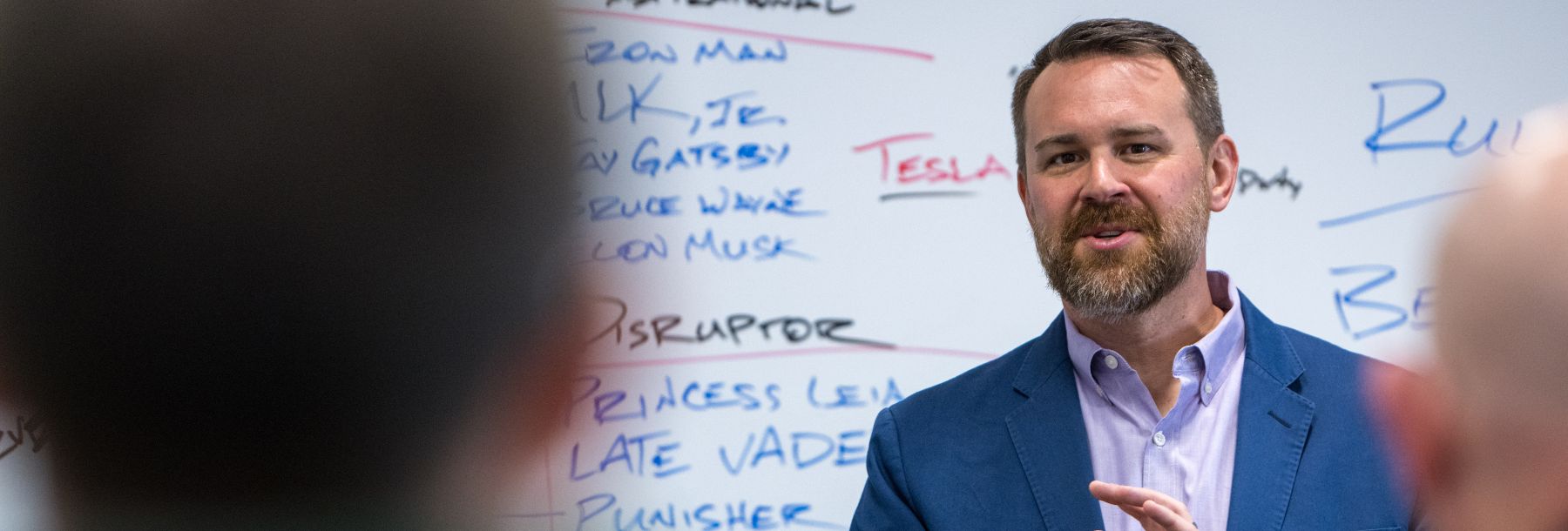
Executive Education Insights: Eric Harris, founder of GatherRound and TCU Neeley Executive Education faculty member, explores why story-driven communication is the key to creating memorable, high-impact presentations that inspire belief and action.
April 24, 2026
By Eric Harris
TCU Neeley Executive Education faculty leader and founder of GatherRound
Think of the last presentation that actually moved you.
Not one that was well-organized. Not one that had clean slides or impressive data. One that changed how you felt about something. One you found yourself thinking about on the drive home, or referencing in a conversation the next week without being asked.
Now think of the last ten presentations you sat through. How many of those can you remember at all?
The gap between those two answers tells you everything you need to know about what’s broken in business communication – and what fixes it.
The memorable ones had a story. The forgettable ones had slides.
I’m not being cute. This is neuroscience.

In a famous Stanford study, MBA students were asked to pitch a product. Only 5% used a story. The rest stuck to data and logic. When listeners were later asked what they remembered, 63% recalled the story. Only 5% remembered a statistic.
We like to believe we’re rational creatures who make decisions based on evidence. Daniel Kahneman’s Nobel Prize-winning research proved otherwise. Most human decision-making doesn’t originate in deliberate, analytical reasoning. It originates in fast, intuitive judgments – what Kahneman called System 1 thinking. Automatic. Emotional. Pattern-driven. System 2, the slower and more logical mode, tends to arrive later – often not to decide, but to justify what already feels right.
Beliefs live in System 1. They’re not assembled line by line. They’re absorbed. Felt to be true before they’re proven to be true. Once a belief is in place, logic becomes a supporting actor, not the lead.
Most presentations are built backwards. They assume that enough evidence will produce the right conclusion. But Kahneman’s work makes clear that belief comes first. Action follows belief. Evidence is recruited afterward to defend what already feels right.
Story works because it speaks the native language of belief. It doesn’t argue. It demonstrates. It doesn’t ask the audience to compute. It invites them to recognize a truth they already sense.
Here’s what happens in the brain when someone hears a well-told story – and why it’s so different from what happens during a typical slide presentation.
When people process raw information, activity is largely confined to language-processing regions of the brain. The words go in. Some of them get decoded. Most get filtered, forgotten, or filed somewhere inaccessible.
When people hear a story, something dramatically different happens. Multiple brain systems engage at once. Emotional processing. Sensory imagery. Memory formation. The listener isn’t just decoding meaning. They’re simulating events. They’re living the story in a small but measurable way.
Princeton neuroscientist Uri Hasson captured this in his research on neural coupling: when someone tells a well-structured story, the listener’s brainwaves begin to mirror the storyteller’s. In some cases, the listener’s brain even predicts what the speaker will say next. That alignment feels like rapport. Like being on the same wavelength – literally.
This doesn’t happen during a bullet-point presentation. It doesn’t happen during a data dump. It only happens when the communication takes the form of narrative.
Psychologist Jonathan Haidt offered a metaphor I think about constantly. He described the mind as a rider on the back of an elephant. Logic is the rider – rational, deliberate, articulate. Emotion is the elephant – powerful, intuitive, and ultimately in charge.
You can’t steer the elephant by tugging the reins. You have to speak to its instincts.
That’s what story does. It speaks to the elephant.
And the elephant is the one who decides whether your audience leans forward or checks their phone. Whether they remember what you said tomorrow or forget it by lunch. Whether they act on your idea or file it alongside the other thirty-seven things competing for their attention this week.
In two decades of coaching leaders on high-stakes presentations, I’ve seen the same thing happen hundreds of times: a smart, capable person walks into a room with a sound strategy, solid data, and a well-organized deck. They present for thirty minutes. The room nods politely. Then everyone goes back to what they were doing before.
The idea didn’t fail. The transfer mechanism failed. Information moved. Belief didn’t.
Now contrast that with the successful presentations I’ve seen—the ones where decisions got made in the room, where people left energized, where the idea traveled beyond the meeting and showed up in hallways and emails and conversations the presenter wasn’t part of. Those presentations had one thing in common. They told a story.
Not a flashy one. Not a theatrical one. A clear, well-structured narrative that helped the audience feel the weight of a problem and see the possibility of a solution. That created tension before offering resolution. That made the idea feel inevitable rather than imposed.
Here’s what I’ve come to believe after sitting through, leading, and coaching thousands of presentations: slides are a container. Data is a resource. Structure is useful. But story is the only vehicle that reliably moves an idea from one mind to another and keeps it alive after the meeting ends.
Stories travel. They leave the room with people. They get paraphrased at dinner tables, retold in hallways, referenced in decisions made weeks later. A deck lives on a server. A story lives in memory.
As Rudyard Kipling wrote, “If history were taught in the form of stories, it would never be forgotten.”
Your ideas deserve that kind of durability. And the people listening to you deserve that kind of care.
The Campfire Method is a new book about unlocking the braver presenter in you. Visit TheCampfireMethod.com to be first to know when it launches.