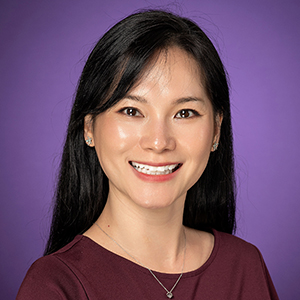
Assistant Professor of Supply Chain Management Ellie Falcone and her coauthors conducted two pioneering studies to uncover how and why corporate social responsibility behaviors spread, stall or diverge across firms—transforming how leaders think about sustainability strategy in supply chain networks.
December 19, 2025
By Neeley Analytics Initiative
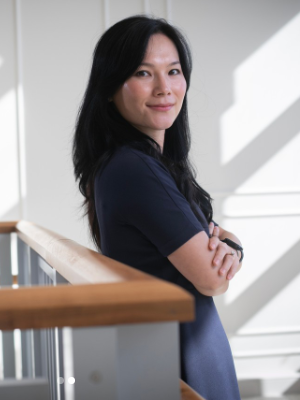 Ellie Falcone, assistant professor of supply chain management, grew up in a family-owned printing business where she observed firsthand that companies care deeply about “doing the right thing,” yet struggle to determine how much to invest in sustainability and whose expectations matter most. This early curiosity followed her into roles in apparel manufacturing and later in healthcare at Baxter, where she repeatedly saw the same puzzle: corporate social responsibility (CSR) is not only ethical; it is relational, shaped by customers, suppliers, and industry norms.
These real-world observations inspired two related studies: “An Investigation of CSR Conformity” and “Follow-Suit or Free-Ride?” both published in the Journal of Operations Management. Together, these studies examine why some companies work hard to match industry sustainability expectations, while others diverge or rely on partners to carry the load.
These findings underscore a central message: sustainability is a networked decision. Firms do not act alone, and understanding the structure and relationships within a supply chain is essential to designing effective CSR strategies for the future.
In the first study, “An Investigation of CSR Conformity”, the research team analyzed over 1,600 firm-year observations to investigate why certain firms conform to industry corporate social responsibility norms. Their findings reveal an inverse-U pattern: mid-sized firms conform the most, while smaller firms often deviate to stand out, and larger firms deviate because they have the influence and resources to lead. Importantly, this pattern shifts depending on how aligned a firm’s supply chain partners are. When suppliers and customers share similar CSR expectations, the pressure to conform weakens.
The second study, “Follow-Suit or Free-Ride?”, drawing on nearly 2,000 firm-year observations, explores how corporate social responsibility practices spread across supply chains. The team found that CSR does not diffuse evenly. Firms tend to imitate their customers’ CSR behavior, yet may free-ride on suppliers, reducing their own CSR efforts when suppliers already demonstrate strong sustainability practices. However, this dynamic changes when suppliers and customers are directly connected to each other. In these “closed triads,” customer influence strengthens, and the temptation to free-ride diminishes.
“Middle-tier firms often feel they must match their peers to maintain legitimacy, while smaller firms may deviate to stand out and larger firms may deviate because they can afford to lead.” said Falcone. “Knowing this helps managers interpret their competitors’ and partners’ CSR choices more accurately and design sustainability strategies that make sense for their network position.”
The implications for managers are substantial. Firms in the middle of a supply chain face stronger pressures to conform, while those at the extremes behave differently. Corporate social responsibility expectations are directional rather than uniform - customers exert strong influence, and suppliers may unintentionally provide room for free-riding. Managers who design more interconnected supply chains will find it easier to encourage consistent sustainability practices across their networks.
Looking ahead, Falcone believes the next step is to examine how environmental, social and governance strategies evolve across multi-tier supply chains, especially as emerging technologies transform sustainability monitoring. There is growing opportunity to explore how artificial intelligence tools reduce free riding, tighten sustainability standards, and reshape the balance of influence between suppliers and customers. She also sees potential for deeper research into how industries coordinate broader transitions, including decarbonization, transparency technologies, and human-rights due diligence.
As a professor in the Business Information Systems Supply Chain Management department, Falcone is passionate about teaching her students the importance of data analytics and its role in shaping the future of business. She believes that success requires an open mindset and a commitment to lifelong learning. By bringing her research into the classroom, Falcone gives students a real-world perspective on how academic insights translate into practical applications. One key piece of advice she shares with students is to remain open-minded and approach all disciplines and career paths with a collaborative perspective, recognizing that academia and industry go hand in hand. Ultimately, she aspires to serve as a bridge between academia and industry, helping to connect research with real-world impact.